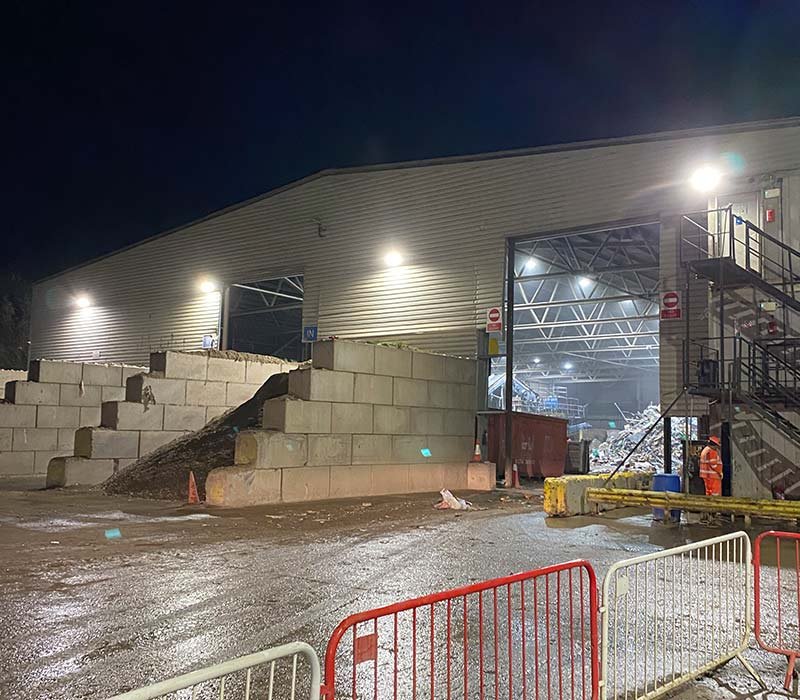
BS 4142 Noise Impact Assessment for 24-Hour Waste Management Facility with Acoustic Mitigation Design

Key Project Details

A detailed noise impact assessment of 24-hour industrial operations, combining on-site monitoring, predictive modelling, and targeted acoustic mitigation.
Survey Type: Industrial noise assessment and mitigation for 24-hour waste operations
What Was Covered: Continuous noise monitoring, tonal/impulse analysis, BS 4142 rating level calculation, acoustic modelling, stakeholder reporting
Equipment Used: Class 1 sound level meters, weather station, triggered audio recording
Analysis Methods: Broadband SPL trend analysis, one-third octave frequency analysis, ISO 3744 SWL derivation, ISO 9613-2 noise propagation modelling, noise footprint validation

Overview

A comprehensive BS 4142 noise assessment was undertaken at a 24-hour waste management facility to evaluate industrial sound emissions and their effect on surrounding receptors. By combining long-term waste management facility noise monitoring, advanced Environmental Noise modelling Software, and field validation, we developed actionable acoustic mitigation strategies that ensured industrial noise compliance, supported planning needs, and fostered community goodwill.

The Challenge

The challenge was to assess round-the-clock operations – including heavy machinery, vehicle movements, and processing equipment – and ensure the waste management facility noise emissions remained within acceptable margins at all hours. The facility’s continuous operation meant that typical quiet periods for measuring background noise were limited, and isolating individual noise sources for measurement was often impractical.

Complaints from nearby receptors highlighted the need for a robust, defensible approach to assess and mitigate noise impact across day and night periods.

Our Solution

Measurement & Source Identification

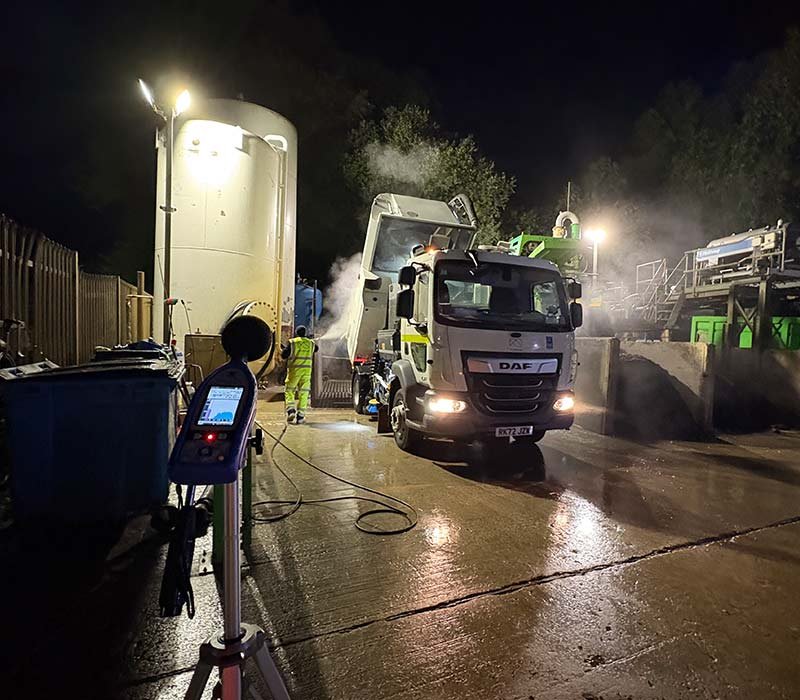
We deployed continuous broadband A-weighted sound level monitoring over several days, capturing site activity trends and identifying peak periods. Spot-check 1/3-octave band analysis was carried out during critical operations. Where possible, individual plant items were assessed using methodologies aligned with ISO 3744 to derive sound power levels (SWLs). Where isolation was not feasible, SWLs were calculated using measured SPLs at known distances. This dual approach ensured a reliable noise source inventory for modelling.

Triggered audio capture was enabled using acoustic fingerprinting to isolate container drops, reversing alarms, or high-energy impacts. These recordings provided timestamped audio of short-duration events and enabled post-analysis confirmation of source identity, supporting character corrections under BS 4142.

Where tonal features met objective prominence criteria (e.g. the one-third-octave side-band test), the appropriate penalties were applied.

Acoustic Modelling

A full 3D model of the site was created using Environmental Noise modelling Software. We implemented ISO 9613-2 propagation algorithms to simulate outdoor sound behaviour and generated noise contour maps across day, evening, and night periods. These predicted noise levels at various distances and at the façades of nearby dwellings, highlighting the noise footprint of the facility and identifying areas of concern.

Crucially, the model computed the specific sound level at each receptor, which we used to calculate the BS 4142 rating levels (including character corrections). These were directly compared with background measurements to assess compliance margins.

Validation & Refinement

To corroborate the model’s predictions, we carried out noise measurements at the nearest residential receptors. The measured contributions were compared against model outputs; where discrepancies were identified, refinements to ground absorption or directivity were applied. This iterative process ensured the final model closely reflected real-world site impact and provided a solid basis for decision-making.

Outcome / Benefit to the Client

The final assessment showed that all predicted BS 4142 rating levels were within acceptable limits, including worst-case night-time operations. Character penalties were transparently justified, and model validation ensured credibility with stakeholders and regulators. The site’s noise footprint was significantly reduced through minor operational adjustments, including improved handling protocols and timing refinements.

Triggered audio events, coupled with acoustic analysis, were also used for internal training, demonstrating the acoustic effect of specific actions and enabling the client to educate staff accordingly.

This project gave the client:

  • Verified industrial noise compliance for their ongoing 24-hour operation
  • A clear, data-driven basis for stakeholder communication and regulatory approval
  • A maintainable, calibrated model for future planning or mitigation iterations

Evidence-based acoustic mitigation strategies targeted to the most effective areas

" Lorem ipsum dolor sit amet, consectetur adipiscing elit. Ut elit tellus, luctus nec ullamcorper mattis, pulvinar dapibus leo "
John Doe
Site Manager