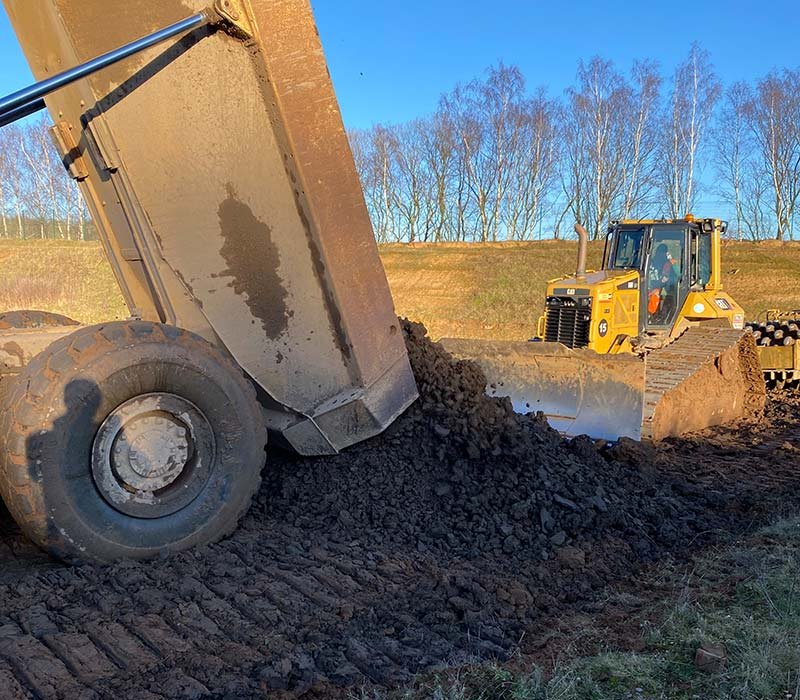
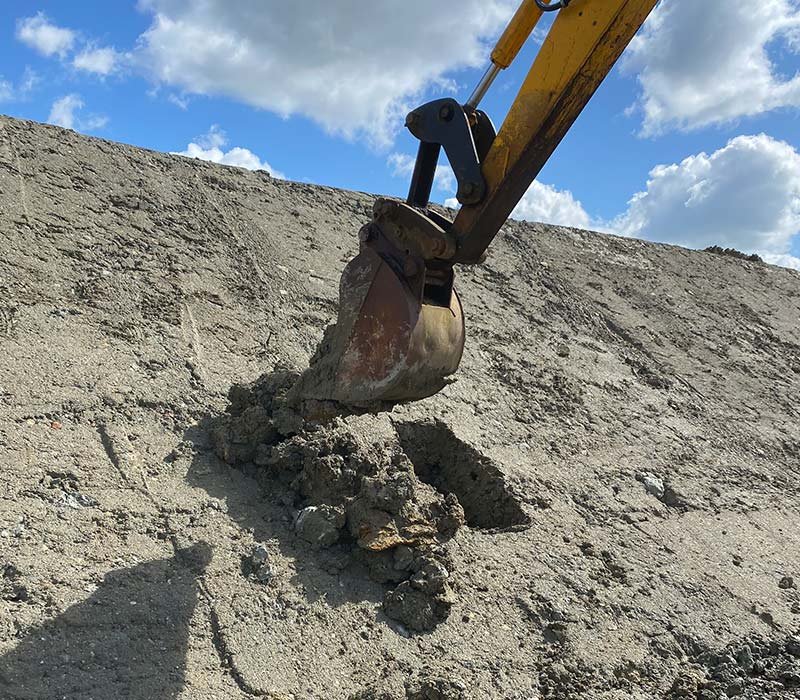
A complex deposit for recovery project was undertaken to restore a former limestone and clay quarry into public open space. The restoration involved phased inert waste placement, engineered zoning, and iterative earthworks volume modelling to manage highly variable ground conditions. By coordinating landfill liner design, managing legacy waste, and integrating groundwater risk management, the site restoration progressed compliantly while supporting long-term environmental and planning objectives, all the while facilitating biodiversity net gain.
Restoring this multi-phased quarry presented a complex engineering and environmental scenario. Excavation had extended through varying clay horizons into underlying limestone, directly exposing sections of the site to the underlying principal aquifer. The variable geology meant that not all areas of the site were naturally sealed, requiring detailed zoning and engineered liner systems to ensure compliance. In addition, an area of historic, illegally tipped hazardous waste was identified, requiring safe excavation, re-engineering, and encapsulation as part of the restoration design.
Further constraints included proximity to a designated SSSI and existing public footpaths, both requiring protection during ongoing operations. The restoration needed to safely accommodate waste placement while enabling progressive aftercare for long-term transition to public open space.
A comprehensive site investigation programme was undertaken to inform the design and develop a robust conceptual site model. Borehole logging, groundwater level monitoring, and laboratory testing characterised both the geology and hydrology across the restoration area. The conceptual site model supported the wider Hydrogeological Risk Assessment (HRA), forming the regulatory basis for landfilling activities and long-term groundwater protection.
The isolated hazardous waste cell was carefully excavated under controlled conditions. Material was relocated into a newly constructed containment area, fully lined to landfill engineering standards. All waste handling, relocation, and placement were conducted under strict supervision, with full Construction Quality Assurance (CQA) documentation maintained for regulator approval. This material was fully accounted for within the wider earthworks volume modelling and restoration programme.
Given the absence of continuous low-permeability clay across the site, engineered solutions were implemented. Site-won clay was identified as a suitable material for liner construction but required processing and compaction to meet regulatory permeability standards. Validation testing demonstrated compliance with required hydraulic conductivity performance criteria, allowing site-won resources to form the landfill liner design while minimising importation of external mineral material.
The site was subdivided into engineered zones; each managed under staged CQA verification to ensure liner integrity. Every phase of inert waste placement was completed under CQA supervision, ensuring that each engineered cell complied with the permitted design before acceptance of waste commenced.
Iterative earthworks volume modelling guided the precise calculation of void capacity, phased material requirements, and restoration levels. This allowed fill volumes to be carefully controlled and optimised across active and future phases. The phased approach allowed efficient material reuse while ensuring that the evolving landform remained compatible with the long-term restoration design.
Boreholes installed across the site were instrumented for continuous groundwater risk management. Water levels were regularly monitored to ensure that the base of engineered waste cells remained safely above the maximum seasonal groundwater fluctuation. Drainage layers, cut-off bunds, and groundwater management systems were incorporated where necessary to protect aquifer integrity throughout restoration.
Surface water drainage design was developed in parallel, using detailed topographic survey data to inform flow routing, drainage runs, and catchment delineation. The strategy supported flood risk mitigation, promoted infiltration, and ensured full environmental compliance with planning and discharge regulations.

Throughout restoration, grading and capping profiles were closely coordinated with landscape architects and ecologists to ensure that phased groundworks aligned with eventual biodiversity net gain delivery. Slope gradients, drainage pathways, and soil placement depths were optimised to enable future establishment of grassland, scrub, and wetland habitats in accordance with restoration objectives.
A detailed BS 4142 noise assessment was undertaken for the quarry’s deposit for recovery project operations. This included predictive modelling and receptor-based measurements to ensure operational compliance. Bunding and temporary screening were designed to reduce both noise and visual impact to sensitive receptors and public footpaths throughout the phased works.
Through detailed technical assessment, coordinated design, and iterative modelling, the client secured a fully permitted restoration strategy that optimised on-site resources while meeting all environmental and planning conditions. Full compliance with deposit for recovery project guidance was achieved, with CQA records maintained throughout all phases to support regulatory inspection and long-term site certification.
The engineered zoning approach successfully enabled continued waste placement while progressively sealing active cells to reduce operational risk. Complex geological interfaces were overcome through validation of processed site-won clay, reducing reliance on imported materials.
The restoration remains fully aligned with long-term planning objectives for public open space creation, while safeguarding the principal aquifer through robust groundwater risk management. Early coordination with ecologists, landscape architects and drainage consultants ensured that all phased works continue to progress in step with future biodiversity net gain delivery.
The project demonstrates the value of precise volume control, phased construction, and cross-disciplinary collaboration in delivering technically robust quarry restorations that integrate operational efficiency with long-term community and environmental benefit.